Collector’s Guide to the Rolex Explorer II Ref. 16570

The Rolex ref. 16570, made from 1989-2011, had by far the longest run of any of the five Explorer II generations so far. The Explorer II, always made in brushed stainless steel with a 24-hour hand and fixed 24-hour bezel, was famously designed for cave explorers (who have no visible indication whether it’s day or night). As the third-generation model, the 16570 was the first Explorer II with a sapphire crystal, and the last one with a stamped clasp and a 40mm diameter. It’s a well-liked yet relatively unhyped watch suitable for almost any occasion. In this guide we’ll cover the specs, evolution and most popular rare variants of the Rolex Explorer II 16570.
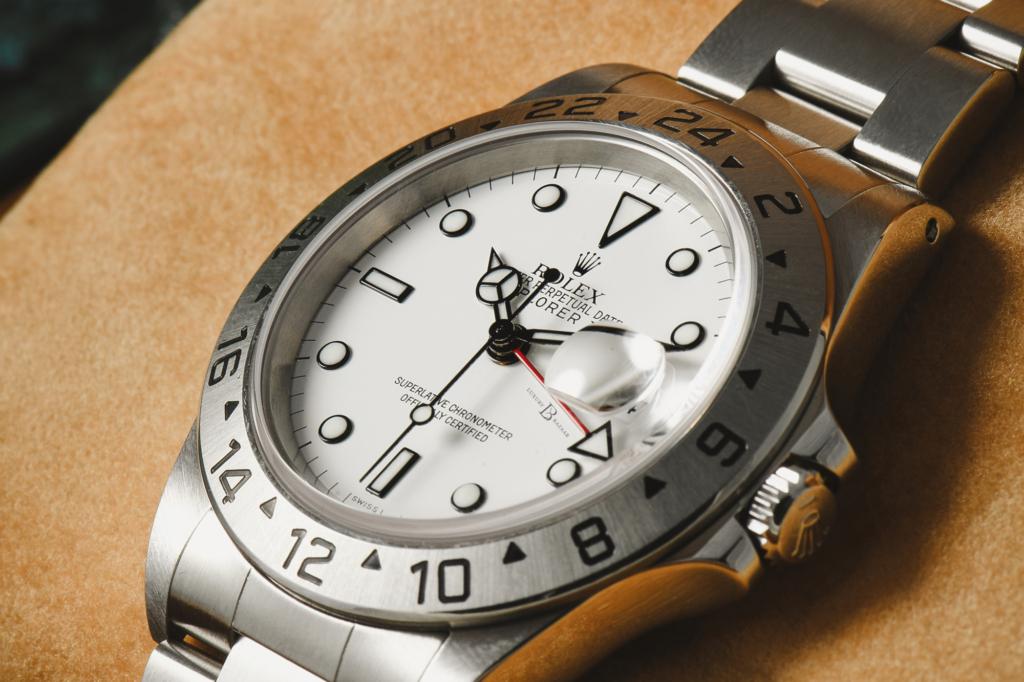
The Basics
The original Explorer II, ref. 1655, is widely known as the “Freccione” (Italian for “arrow”) because of its giant arrow-shaped 24-hour hand. The 1655, made from about 1971-1984, is the only Explorer II that is not a GMT watch–its 24-hour hand is synced to the hour hand–and also the only one that was not offered with a white dial.
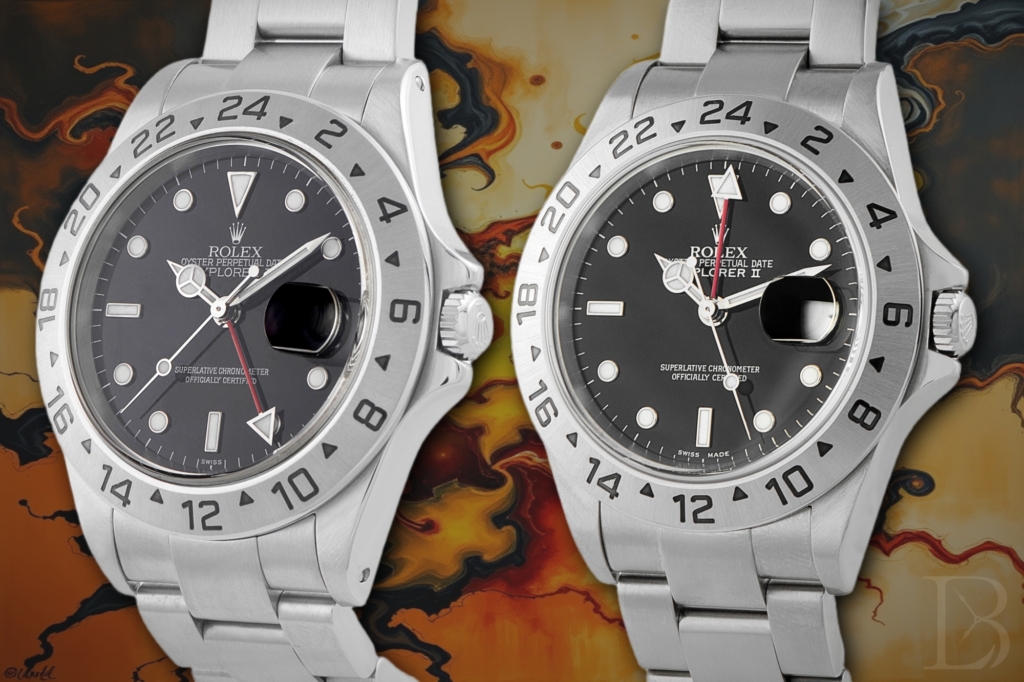
The Rolex 16570, like its transitional predecessor, ref. 16550 (1985-1989), as well as every Explorer II since, features an independent 24-hour hand and was offered with a black or white dial.
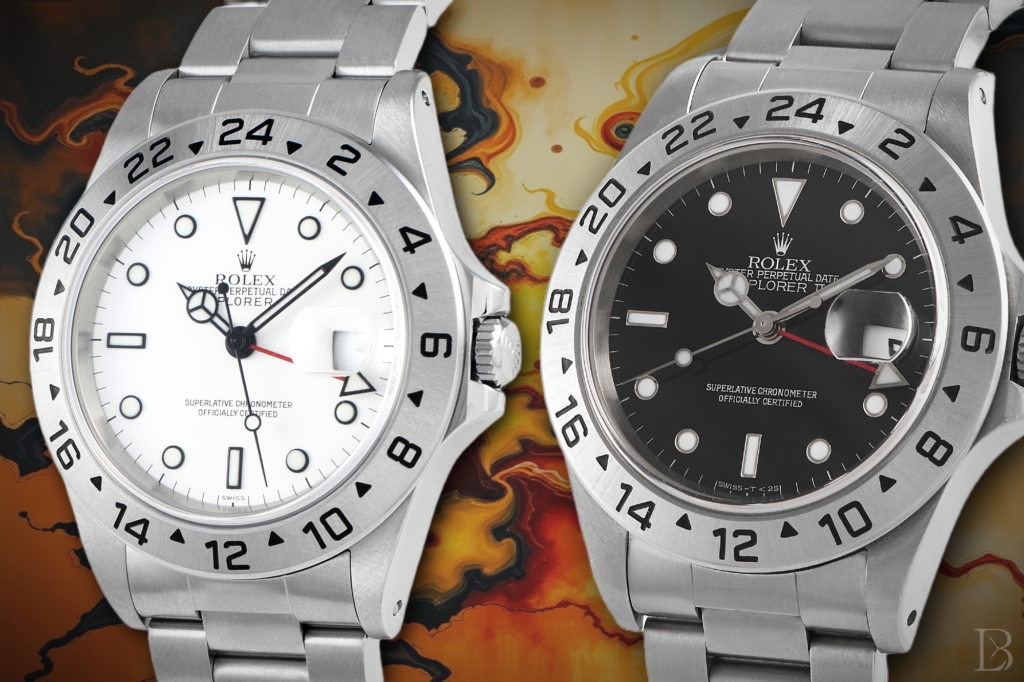
There are no other options on the Explorer II: there is only one size offered at a time (40mm until 2011 and 42mm since then), one bracelet (a fully brushed Oyster), and one material (stainless steel). White-dial Explorer II models are known as “Polar” while the black ones never got a cute Rolex nickname.
The Polar Explorer II tends to get more attention than its black equivalent, perhaps because the black outlines of its hands and hour markers make it somewhat unique in the Rolex lineup. But I think the black Rolex 16570 looks awesome in person, and I named it as one of the most underrated Rolex models.
Before I go over the evolution of the 16570, and all the changes worth knowing about, here’s a breakdown of the specs:
Rolex 16570 Specs
| Model | Explorer II |
| Reference | 16570 (Lugholes, 1989-2002) 16710T (No lugholes, 2003-2011) |
| Case Material | Stainless steel |
| Case Size | Diameter: 40mm Thickness: 12mm Lug-to-lug: 47mm |
| Water Resistance | 100m |
| Movement | Caliber 3185 (1989-2007) Caliber 3186 (2007-2011) |
| Functions | Hours, minutes, second, date, GMT |
| Power Reserve | 48-50 hours |
| Bracelet/Strap | Stainless steel Oyster bracelet (Hollow endlinks until 2000) |
| Market Value (2026) | $8,000 (Typical) $11,000 (Porcelain) $15,000 (Chicchi Di Mais) $22,000 (Cream) |
Looking at the specs above, you might be asking if the Rolex 16570 is essentially a Rolex GMT-Master II ref. 16710 with a different bezel. And the answer is yes. It’s basically a 16710 with a fixed steel bezel.
Rolex 16570 Timeline
The Rolex Explorer II ref. 16570 went through several changes during its 22-year-run. We’ve summed it all up in one image:
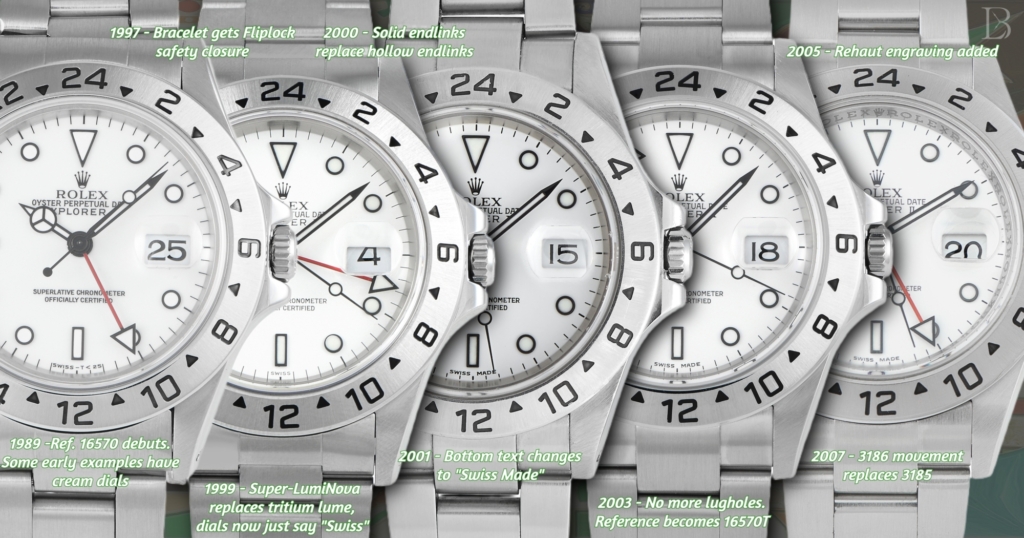
| 1989 | Ref. 16570 debuts. It’s the first Explorer II with a sapphire crystal. The 3185 movement replaces the outgoing 3085 from the short-lived 16550. |
| 1997 | Fliplock safety catch added to the bracelet. |
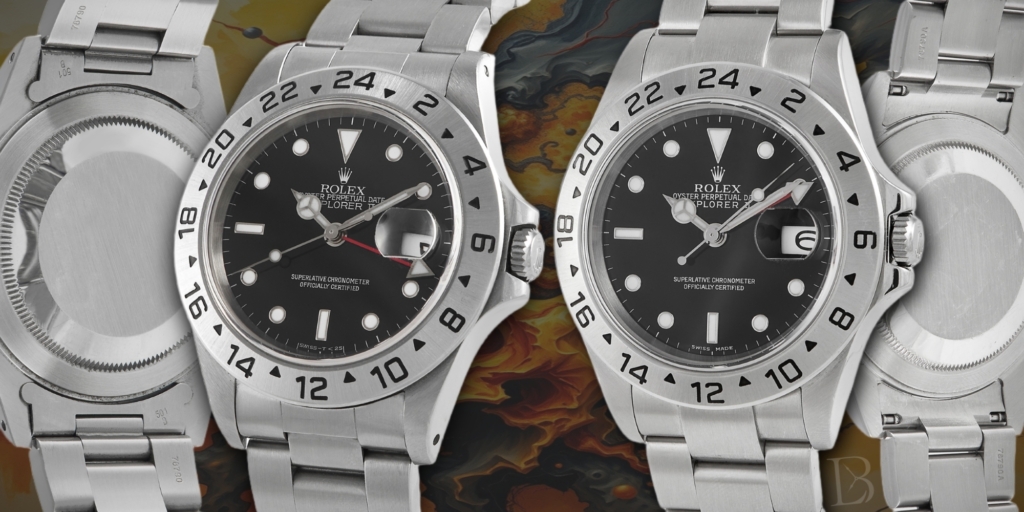
| 1999 | Tritium lume is gone in favor of non-radioactive Super-LumiNova. “Swiss T < 25” is replaced by only “Swiss.” |
| 2000 | All Rolex sports models get solid endlinks (“SEL”), except for the Submariner 14060M. |
| 2001 | The Swiss-only dials are gone; they now say “Swiss Made.” |
| 2003 | No more lugholes! The new lughole-free reference is known as 16570T. |
| 2005 | The engraved Rolex rehaut begins to appear on ref. 16570T. |
| 2007 | 3186 movement replaces 3185. |
| 2011 | Rolex 16570 discontinued, replaced by the larger 216570. |
Bracelets
The Rolex Explorer II, with no exceptions, comes on a fully brushed stainless steel Oyster bracelet.
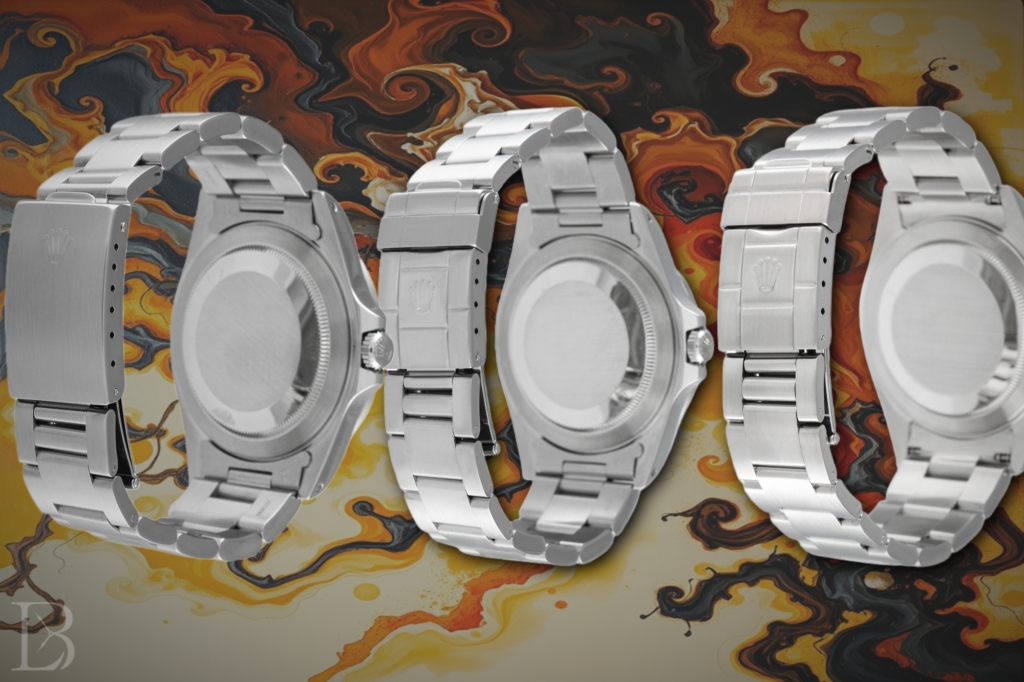
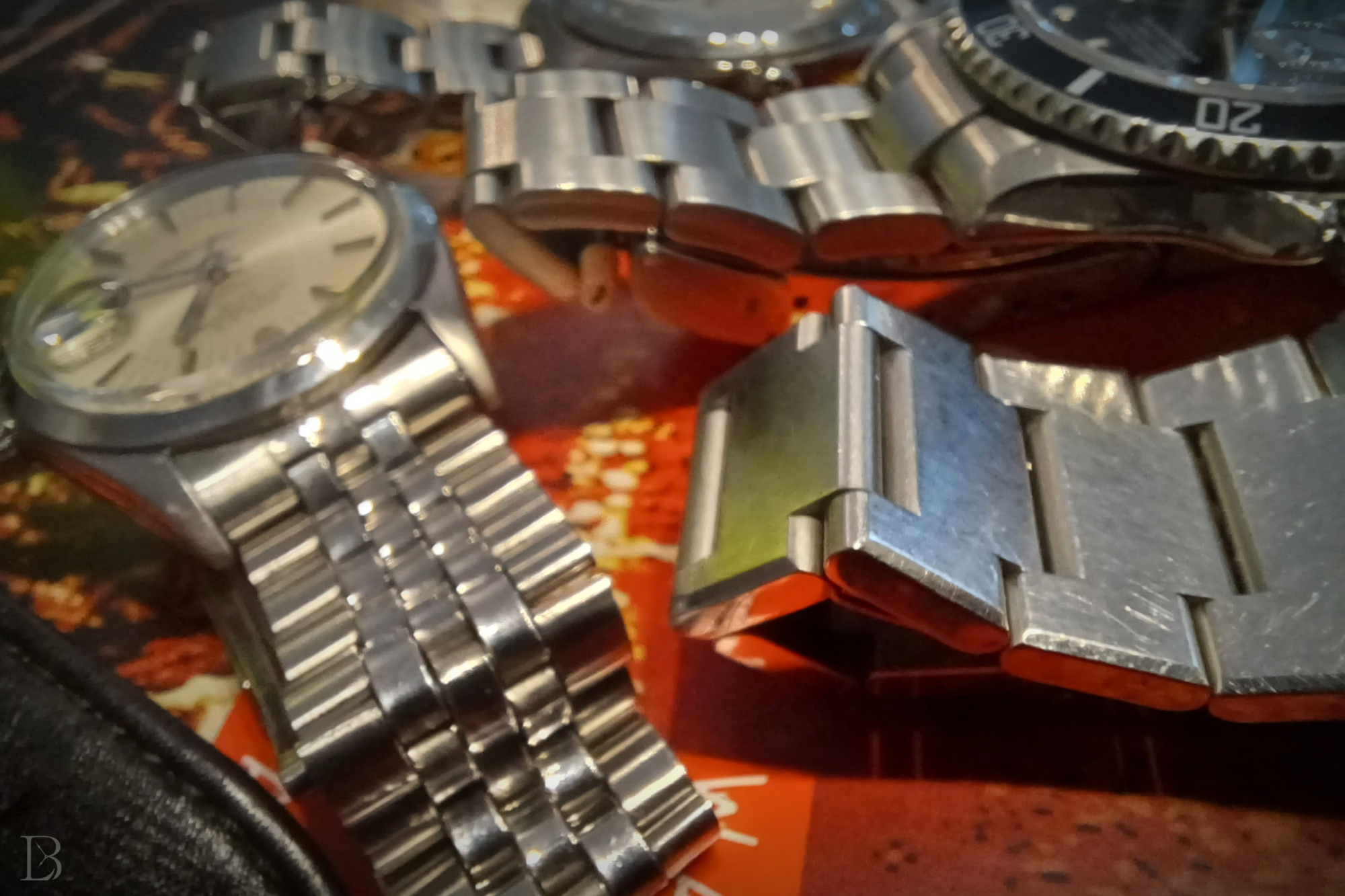
The Rolex 16570 initially came on a 78360 Oyster with hollow endlinks (HEL). It had no safety catch, so the bracelet could be opened with one motion, but by 1997 the Fliplock feature was added and the bracelet number became 78790. The 78790A bracelet added solid endlinks (SEL) in 2000. Here’s a quick breakdown:
| Bracelet Ref. | End Link Code | End Link Type | Safety Catch | Production Years |
|---|---|---|---|---|
| 78360 | 501B | HEL | No | 1989–1997 |
| 78790 | 501B | HEL | Yes | 1997–2000 |
| 78790A | 801 | SEL | Yes | 2000–2011 |
If it looks like the Oyster bracelet goes into the endlink, those are hollow endlinks. With solid endlinks, the center link goes right up to the lip of the bezel. You can see our Rolex bracelet guide for a deep dive on the topic.
More on Rolex:

Desirable Variants of the Rolex 16570 Explorer II
There are three main types of “special” Rolex Explorer 16570 variants worth mentioning from a collector standpoint. Note that they are all Polar Explorer II variants. Black 16570’s generally all sell for around the same price, with the exception of ones with Tiffany & Co. stamps.
- Chicchi Di Mais dials (Italian for “kernels of corn”) are so named because their hour plots have turned a particularly deep yellow color. It’s just heavy patina on the hour plots–that’s it. But it does look nice. On a “true” Chicchi di Mais dial, there is a striking and pleasant contrast between the yellow (maybe even yellow-orange) hour plots and the dial. But as with all collectible Rolex variations, sellers often really stretch the meaning of the term, so you might even see a 16570 with extremely mild patina called a “Chicchi di Mais.” But using that term for any Polar Explorer with slightly yellow hour plots is incorrect in my book.
- Cream Rolex 16570 dials are simply early 16570 dials that have a paint defect that caused them to age (beautifully) to a rich cream color. There is an entire spectrum of possible colors between paper-white and dark-cream, but 16570’s that turn cream are usually less extreme (meaning lighter) than the more well-known cream 16550’s made in the years prior.
- Porcelain dials have an attractive “bowl of skim milk” sheen to them. It is generally accepted that they came early in the 16570’s run (1989-1991) but I believe there might be some as late as 1997. There was definitely plenty of overlap with “normal” white Explorer II dials.
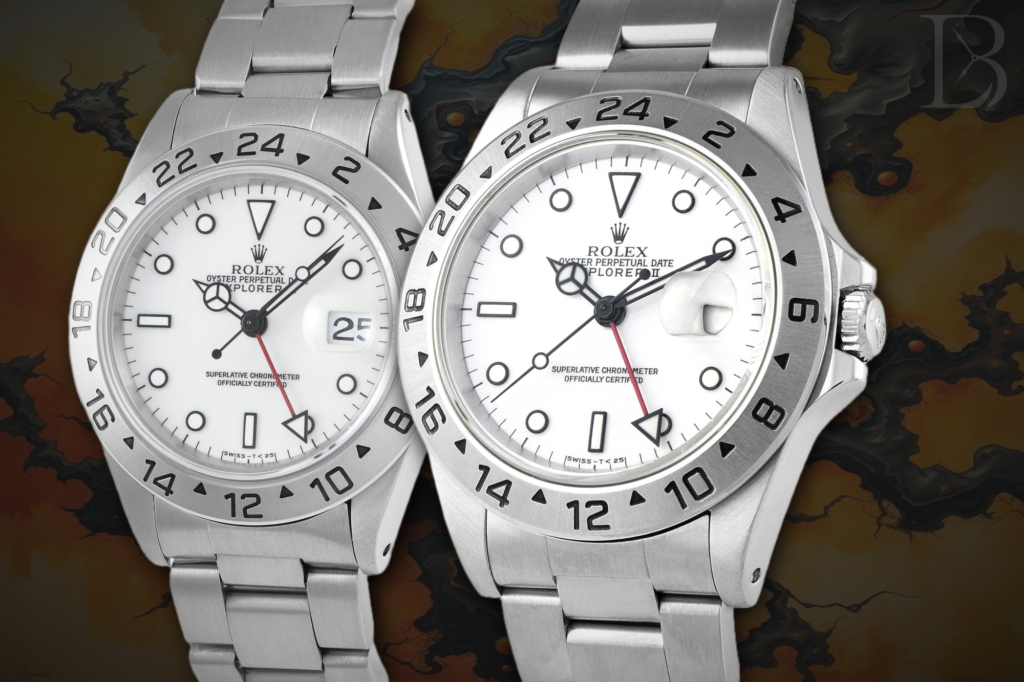
The term “rail dial” refers to a Rolex dial where the space between the words “Superlative” and “Chronometer” is aligned with the space between “Officially” and “Certified.” That’s it. It’s relatively rare, and is only seen on the earliest 16570’s, but it doesn’t affect the price all that much. I feel like rail dials got more hype years ago.
More on Rolex:
Rolex 16570 vs. 16550
The Rolex Explorer II 16570 is very similar to its predecessor, ref. 16550. Here’s how to tell them apart:
- Ref. 16550 has the caliber 3035 movement, whereas the 16570 has the slightly updated 3185 (and later 3186). A tip to test: On 30xx movements, the hands advance when you move the crown counterclockwise; on 31xx movements it’s clockwise.
- 16550 has an acrylic crystal; 16570 has a sapphire crystal.
- If a Polar Explorer II has white gold surrounds and hands, it’s a definitely a 16550. The black dial/hand accents came at the end of the 16550’s run, so an Explorer II with black surrounds can be a late 16550. But most are 16570’s.
Also, the 16570 is made of 904L stainless steel, rather than the more common 316L of the 16550, but that’s not something you can detect visually.
3185 vs. 3186 Movement
The Rolex 16570 got a 3186 for the last few years of its run, replacing the outgoing 3185. The 3186 has a Parachrom hairspring, and thus greater magnetic resistance, but there’s really nothing wrong with the old Nivarox hairsprings. If you have a Rolex 16570 with no engraving on the rehaut, it has a 3185.
If it does have the engraving, it almost always has the 3186. But some of the first engraved-rehaut ones (2005-2006) do still have the 3185. On the 3185, the 24-hour hand “wiggles” a bit when you set it, while that wiggle is pretty much gone on the 3186. But the 3185 is a perfectly good movement and having the 3186 doesn’t materially affect the value.
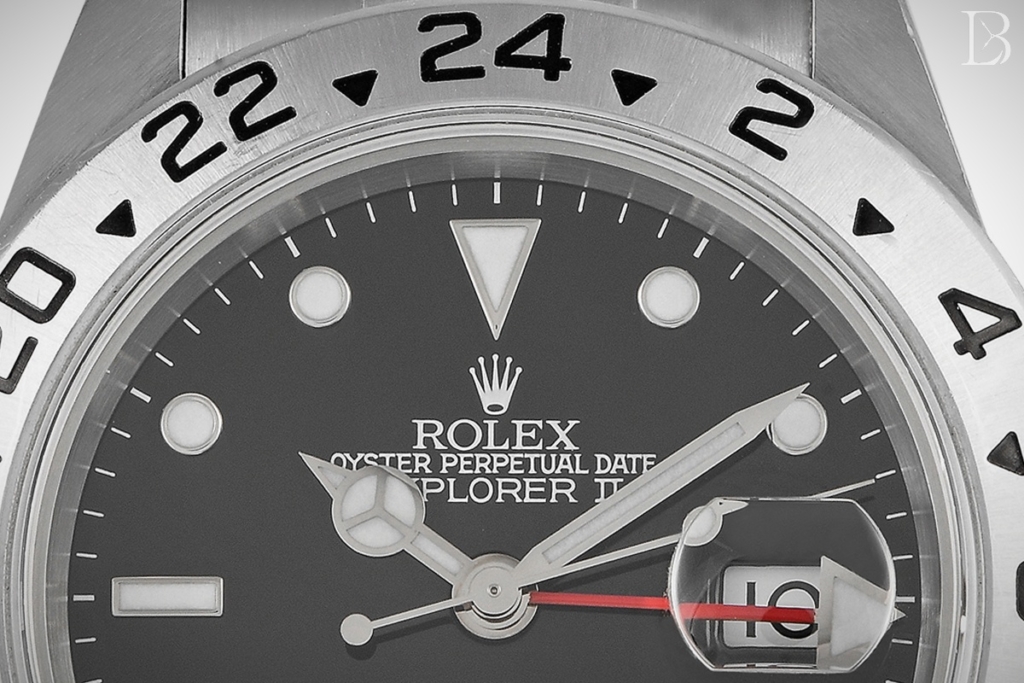
Even in excellent condition the Rolex Explorer II ref. 16570 is readily available for $8,000 or less, which is a (relatively) good value in the world of Rolex sports models. And it’s a popular choice for a “one-watch collection” for a reason.



Leave a Reply